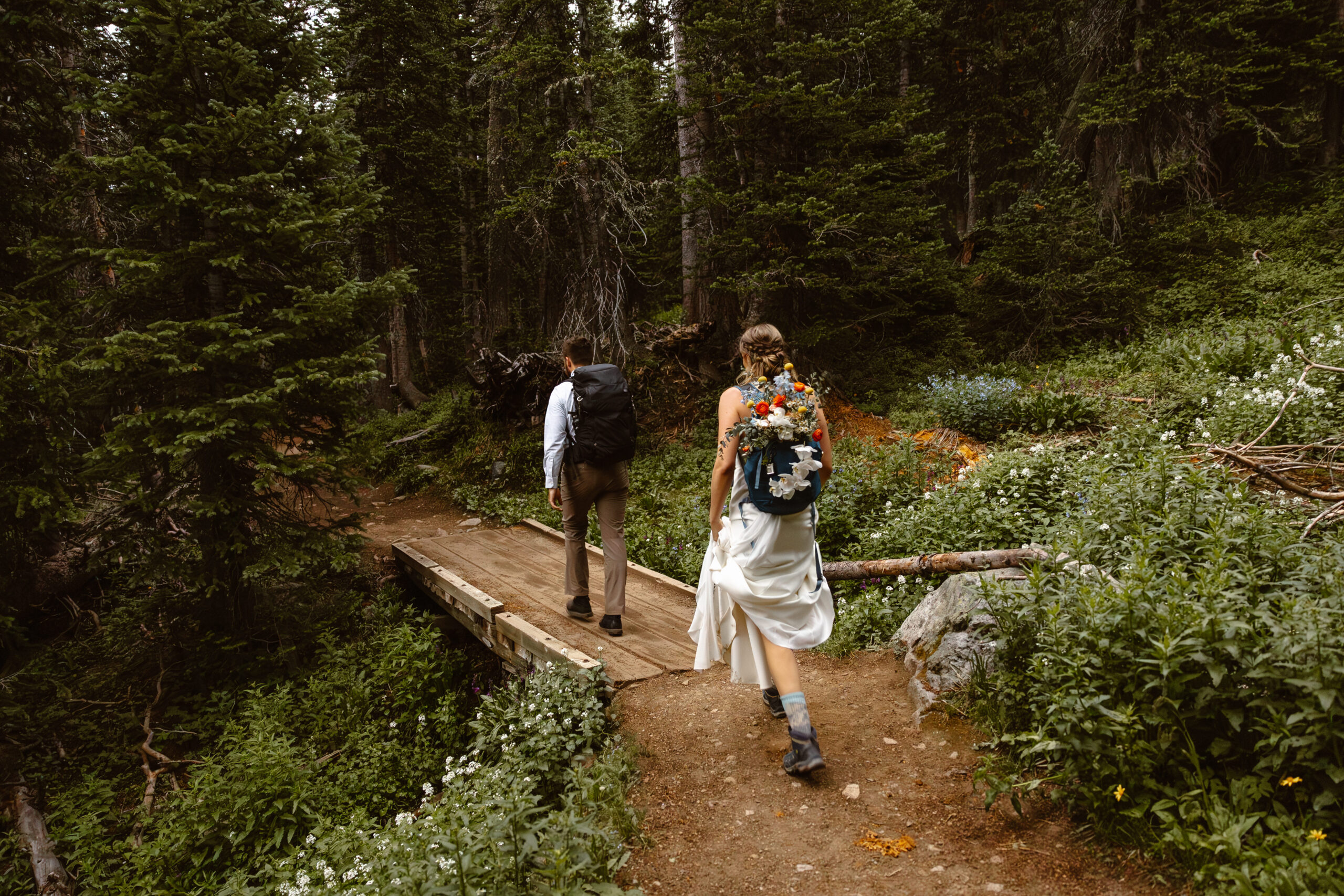
Ask ten photographers the best time of year to elope in the Blue Ridge Mountains, and you’ll get ten different answers. Here’s mine, season by season.
Most couples land on October, and honestly, fair. The fall color here is what people fly across the country for. It’s also the hardest thing in these mountains to predict, which is partly why October gets picked by default. It feels like the safest bet.
But your date decides what the mountains actually look like on your wedding day. Whether you’re sharing your ceremony spot with forty strangers. Whether the road to that overlook you’ve had saved for a year is even open.
So here’s the real breakdown, good and bad:
The short answer
If you want fall color and you’re okay with people, go mid-October and get married on a weekday.
If you want the mountains mostly to yourselves, go late April, early May, or the first two weeks of November.


Spring: April through early June
Spring in the Blue Ridge is the season people forget about, and it might be the best-kept secret in these mountains.
Everything is waking up. The hardwoods leaf out, and everything turns an absurd shade of green. Waterfalls run hard from snowmelt and spring rain, which means Linville Falls and the Dupont waterfalls are at their most dramatic. Rhododendron and mountain laurel bloom through late May and June, and the flame azalea display at Roan Mountain in June is genuinely one of the most beautiful things in the eastern United States.
Crowds are light. Lodging is affordable. And you can have an overlook all to yourselves on a Tuesday morning in May.
The tradeoff: spring weather here is moody. April can hand you seventy degrees and sun or forty degrees and sideways rain…sometimes in the same afternoon. Higher elevations stay cold well into May. You need a real backup plan, which you should have anyway.
Best for: couples who want waterfalls, privacy, and don’t need a guarantee of what the sky will look like.

Summer: mid-June through August
Long days, the underrated advantage. Sunrise around six, sunset after eight, giving you the ability to do a sunrise ceremony and still have a full day OR split coverage across two days without either one feeling rushed.
Everything is deep green. Fog sits in the valleys in the mornings and looks absolutely unreal in photos. The synchronus fireflies at Elkmont in late May and early June are a genuine bucket-list phenomenon, though they run on a lottery system and you’ll need to plan for it well ahead.
The tradeoff: heat, humidity, and haze. Afternoon thunderstorms are pretty much a daily occurrence in July and August, which sounds worse than it is because they’re usually brief and build in the afternoon. We just plan around them. The bigger issue is that summer haze flattens those long-range mountain views, so if the layered blue ridgelines are what you’re picturing, summer isn’t when they look their best.
Best for: couples who want long days, forest and waterfall settings rather than big vistas, and a two-day timeline.

Fall: late September through early November
This is what you’ve probably seen the most on Pinterest, and it earns the hype.
Here’s the thing almost nobody explains properly: fall color doesn’t peak everywhere at once. It moves downhill.
- Above 5,000 feet, color peaks late September into the first week of October
- Between 3,000 and 5,000 feet, roughly October 10th through 25th
- Below 3,000 feet, including Asheville itself, late October into early November
That’s a five-week window, not a weekend, and it shifts year to year depending on rainfall and temperature. Nobody can promise you peak color on a specific date, including me. What I can do is help you narrow down the best window for the elevation you’re drawn to, and that’s a real part of what location scouting involves. It’s the difference between showing up at peak and showing up a week late.
The tradeoff: everyone else is here too. October weekends in western North Carolina sell out quickly for lodging, sometimes by August. Popular overlooks fill their parking areas by nine in the morning. Great Smoky Mountains is the most visited national park in the country, and October is when you feel it the most.
The fix is simple, and most couples won’t do it: get married on a weekday. The same overlook with a thirty-minute parking wait on Saturday is often empty on Tuesday. – especially in the morning. Monday through Thursday in October gets you peak color and a fraction of the people. If you’re already eloping, chances are you’ve thrown out the rules about which day a wedding happens on. Lean into that.
One more thing nobody tells you until it’s too late: the Blue Ridge Parkway doesn’t issue ceremony permits during the entire month of October. Not one. So if fall color is what you’re after, consider Pisgah National Forest land instead, where small groups don’t need a permit at all. Completely fine once you know, genuinely stressful if you find out in September. I break down the entire permit situation in my North Carolina elopement guide.
Best for: couples who want the fall color, will go midweek, and book early.

Winter: late November through March
Almost nobody elopes here in winter. That’s the point.
The trees are bare, which means the long-range views open up completely. November in particular is often the clearest month of the year, with low humidity and no leaves blocking the ridgelines. Higher summits get rime ice, that white feathered frost that coats everything and looks like another planet. Snow is real but not constant, so you get winter drama without a guaranteed blizzard.
You will have the mountains to yourself. Lodging is cheap.
The tradeoff, and it’s a significant one: large sections of the Blue Ridge Parkway close from late November through March due to ice and snow, and those closures happen with little warning. Many of the overlooks people picture are simply unreachable. Winter elopements here require flexible location planning and a photographer who knows which spots stay accessible.
Best for: couples who want solitude, don’t mind cold, and are willing to stay flexible on location.
One thing to know before you plan anything
Hurricane Helene hit these mountains hard in September 2024 and caused the largest disaster in National Park Service history by damage cost. If you’ve read anything about the Blue Ridge Parkway being closed, that’s where it comes from.
Here’s where it actually stands. Most of the 469-mile Parkway has reopened. Roughly 35 – 40 miles remain closed, concentrated in the stretch between Linville Falls and Mount Mitchell, where crews are still working through landslide repair sites. The Park Service is aiming for a reopening by the end of 2026.
For a 2027 elopement, that means the Parkway should be fully open by your date.
I track Parkway closures and trail conditions as part of planning. If a location you’re attached to isn’t accessible for your date, I’ll tell you early and find you something better. Better to know in March than to find out on your wedding morning.
If you want to check for yourself, the Park Service keeps a current road status page: nps.gov/blri/planyourvisit/roadclosures.htm
The practical stuff
Book earlier than you think. October dates go first, often a year out.
Weekdays beat weekends in every season, and dramatically so in October.
Marriage license: North Carolina has no waiting period or residency requirement, but the license expires after sixty days, so don’t get it too early either. Full breakdown in my North Carolina marriage license guide.
Permits vary by location, and some require lead time. That’s part of what I handle.
So which season should you pick?
Start with what you want the photos to feel like, not what month is convenient.
Big layered blue ridgelines: fall or November. Waterfalls at full force: spring. Deep green forest and fog: summer. Solitude and stark open views: winter.
Planning a Blue Ridge elopement? Here’s how I help couples plan the whole thing, from location scouting through permits and timeline. Blue Ridge elopement photographer →