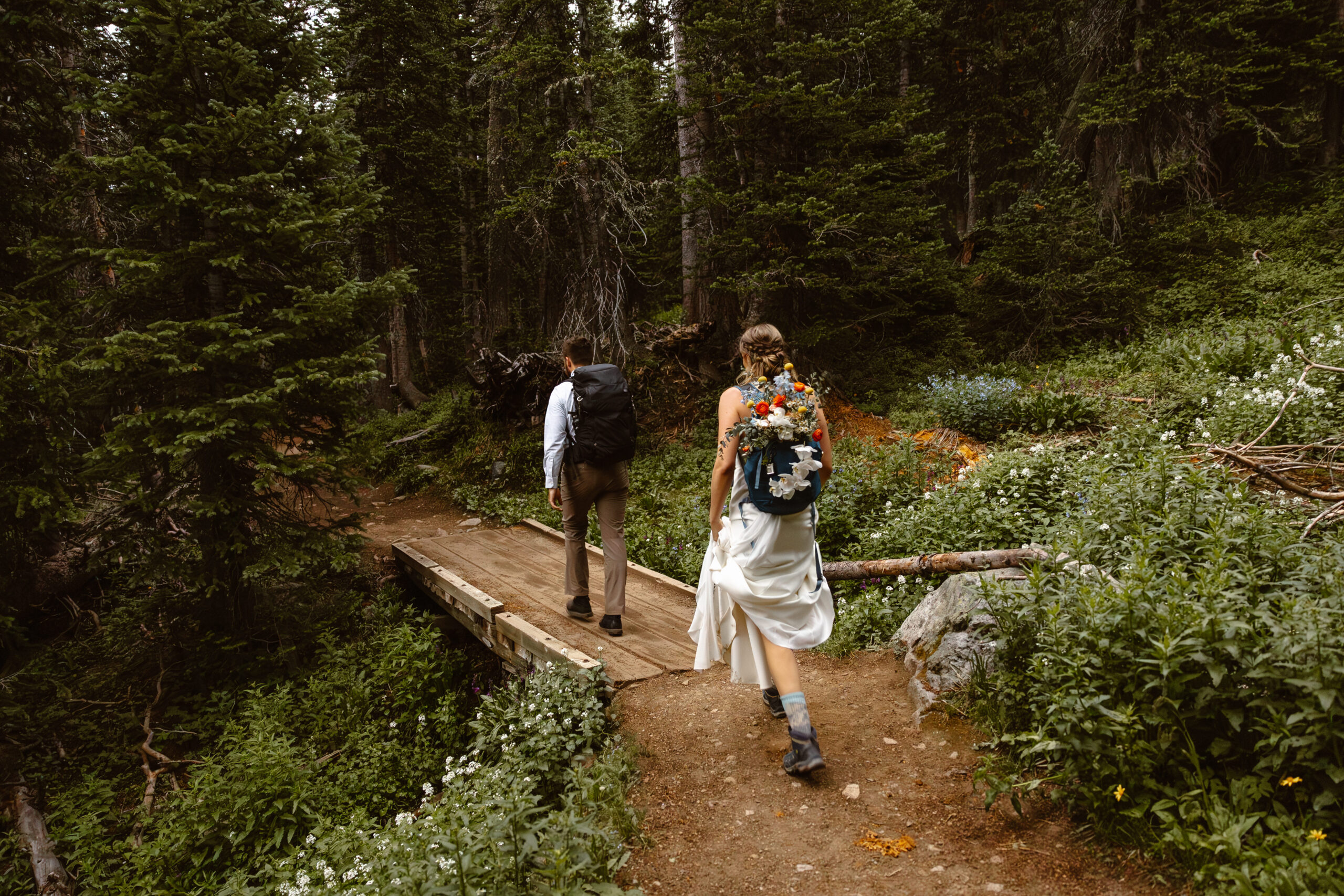
There’s something about the Blue Ridge Mountains that feels like it was made for the quiet kind of love. The kind that doesn’t need an audience, a seating chart, or a DJ playing songs you didn’t pick. The mist rolls in low over the ridgeline in the early morning, rhododendrons bloom in wild, tangled canopies, and the whole landscape has this deep, unhurried presence.
If you’ve been dreaming of a wedding day built around the two of you, your story, and a place that genuinely takes your breath away, eloping in the Blue Ridge Mountains of North Carolina might be exactly what you’ve been looking for.
This guide covers how to elope in North Carolina from start to finish: the legal fine print, the best locations, where to stay, how to celebrate after, and the details that turn a ceremony into an entire unforgettable day.

Navigating the legal requirements for a North Carolina elopement
Let’s start with the practical stuff, because nothing derails a dreamy elopement faster than a paperwork surprise.
The marriage license
To legally get married in North Carolina, you’ll need a marriage license issued by a register of deeds office. The good news: it’s valid immediately after you receive it, so there’s no waiting period. Just use it within 60 days or you’ll need to apply for a new one. Both of you need to appear in person with a valid photo ID.
I wrote a whole post on this if you want the county-by-county details: How to Get a Marriage License in North Carolina.
The witness rule
Here’s where North Carolina differs from states like Colorado. NC requires two witnesses, each at least 18 years old, to be present and sign your marriage license. This is a firm legal requirement, so plan for it early.
The officiant rule
North Carolina requires an ordained minister or a magistrate to perform your ceremony. Worth knowing if you were hoping to self-solemnize, because NC doesn’t allow it the way Colorado does.
Here’s the good news: I’m ordained, which means I can legally marry you in North Carolina. No finding a separate officiant, no hiring someone you’ve never met. If you want your ceremony to feel private and personal, I’ve got you covered.
Two legal details to keep straight:
The officiant and the witnesses are separate roles. If I’m officiating, I can’t also sign as one of your witnesses. Those are two distinct signatures on the license.
What if you want it to be just the two of you? You still need two witnesses present who are 18 or older. If you’re envisioning something truly minimal, a videographer, a private chef, or a friendly fellow hiker on the trail can fill that role. It’s more flexible than it sounds, and honestly, asking a stranger on a mountaintop to witness your vows makes for a pretty good story.
One workaround for a genuinely intimate elopement: I officiate, you bring one person to witness, and we recruit a second on the day. Or we add a videographer to the team and they double as your witness. Simple, legal, and still completely yours.

Where to elope: Blue Ridge Parkway vs. Pisgah National Forest
The two main types of public land you’ll choose between are the Blue Ridge Parkway and Pisgah National Forest. They have very different permitting rules, vibes, and logistics. Here’s the breakdown:
A note on Hurricane Helene recovery
Before you fall in love with a specific overlook, know the current state of the Parkway. Hurricane Helene hit Western North Carolina hard in September 2024. Most of the Parkway has reopened, but sections remain closed while crews work through landslide repairs, and the Park Service is targeting full reopening by the end of 2026. Closures in the affected stretch can shift without much notice, though.
If you’re planning for 2027, this likely won’t affect you at all. Either way, check the Park Service’s current road status page before you commit to a location: nps.gov/blri/planyourvisit/roadclosures.htm
Tracking this is part of what I do during planning. If a spot you love isn’t accessible for your date, I’ll tell you early and find you something better.
Option 1: The Blue Ridge Parkway (permit required)
The Parkway is iconic for a reason. Sweeping ridgeline views, accessible overlooks, and that classic misty mountain atmosphere. It also comes with more structure.
Every ceremony on the Blue Ridge Parkway requires a Special Use Permit, regardless of group size. Here’s how to get one:
- Download the Special Use Permit application from the Park Service
- Pay the non-refundable application and processing fee at pay.gov. Search “Blue Ridge Parkway,” then select “Blue Ridge Parkway Special Use Permit Fees.” No cash or checks.
- Email your completed application to BLRI_Permits@nps.gov at least 30 days before your date. Earlier is always better.
- Wait for approval. You’ll be contacted either way.
The permit covers a two-hour ceremony window and allows up to 25 guests at most locations, though some spots are capped lower. It does not cover receptions.
Not allowed on the Parkway: open flames including candles, live or dried natural flowers and bouquets, arches or arbors, amplified music, alcohol, and throwing rice or confetti. If any of those are non-negotiable, Pisgah is a better fit.
One timing note that catches people off guard: permits aren’t issued during the entire month of October or on federal holidays. So if you’re chasing peak fall color, you’re looking at a Pisgah location instead. More on how to time that in my guide to [the best time of year to elope in the Blue Ridge].
Popular Parkway ceremony spots near Asheville:
- Craggy Flats Bald — twisted rhododendron canopies and sweeping views, one of the most iconic spots near Asheville. Check current status before applying. Craggy Pinnacle specifically does not allow permits regardless.
- Buck Spring Gap — easily accessible, multiple tucked-away ceremony spots, minimal road noise, short under-a-mile round trip. Good if some guests aren’t up for a long walk.
- Beacon Heights Trail, right fork only — an easy mile round trip that opens onto great mountain views. Solid ceremony-plus-short-hike combination.
- Chestoa View Overlook — limited to 12 total participants (including vendors), but beautiful and accessible with strong views.
- Haywood Jackson Overlook and Roy Taylor Overlook — further south near the end of the NC stretch, good alternatives if northern locations are affected by closures.
Important for portrait-only sessions: if you’re using a Parkway trail just for photos and not exchanging vows, no permit is required. So some couples hold the legal ceremony at a Pisgah location with no permit needed, then drive to a Parkway overlook for portraits. Best of both worlds.
Option 2: Pisgah National Forest (usually no permit needed)
This is where things feel a lot more like Colorado’s national forest land, and it’s one of the reasons I love shooting elopements here.
Weddings with fewer than nine guests on Pisgah National Forest land don’t require a Special Use Permit. You follow Leave No Trace, stay on established trails, pack out everything you bring in, and leave the place better than you found it. No fee, no 30-day lead time, no October blackout. Just you, the mountains, and a lot more freedom.
Ground rules that do apply:
- No chairs, arbors, or ceremony structures
- No decorations attached to trees or signage
- No confetti, rose petals, or birdseed
- Be respectful, keep noise down for other trail users
Black Balsam Knob. If you want wide-open sky, wind in your hair, and a 360-degree panorama that goes on forever, this is the one. A high-altitude bald above the treeline along the Art Loeb Trail, with some of the most dramatic scenery in the region. No permit needed for small groups, incredible at sunset, and genuinely unlike anywhere else in the East.
Looking Glass Falls and the Pisgah waterfalls. For a ceremony that’s more sensory than panoramic, the roar of rushing water, cool mist, moss-covered boulders and towering hemlocks, the waterfall corridors are hard to beat. Looking Glass Falls is the most accessible and one of the most beautiful, though easy access means it gets busy. Timing is everything. Weekday mornings or early arrivals give you the quiet you’re after. There are lesser-known falls nearby worth the extra mile of trail.
For the adventure seekers: ceremony here, hike there – Bonus Option
Hands down one of my favorite ways to structure a Blue Ridge elopement. Split the day. Legal ceremony at one location, then hike or travel to somewhere more remote for portraits and celebration.
Ceremony at a designated Parkway site or accessible Pisgah trailhead, then hike up to a more dramatic, private ridgeline for photos and champagne. No crowds, better views, and a story that feels like a real adventure rather than a photo op.
Combinations that work especially well:
- Ceremony at Buck Spring Gap, then hike the Art Loeb Trail toward Black Balsam for portraits on the open balds
- Ceremony at a Pisgah waterfall, then drive up to a Parkway overlook for golden hour portraits (no permit needed for portraits only)
- Ceremony at Craggy Gardens with a permit, then hike toward Craggy Pinnacle for private ridgeline time after the two-hour window


Design-forward lodging for a multi-day elopement
One of the best parts of an elopement is that your lodging becomes part of the story. The slow morning in a fog-wrapped cabin, coffee on the deck with the mountains behind you, golden light through the windows while you get ready. All of that is your wedding day, and it deserves to be somewhere beautiful.
Asheville and Marshall: modern, architectural, elevated. If you’re drawn to clean lines, thoughtful design, and a little urban energy between mountain adventures, the Asheville area delivers. Look at design-forward boutique properties in town, or luxury cabins tucked into the wooded hillsides just outside it. Marshall, a small river town about 20 minutes north, has an increasingly artsy character and some genuinely unique properties along the French Broad.
Boone, Blowing Rock, and Banner Elk: nostalgic, cozy, elevated camp. For the couple who wants their elopement to feel like a Wes Anderson mountain escape. Vintage details, A-frames, stone fireplaces, maybe some plaid. Boone and Blowing Rock have a charming small-town feel, and Banner Elk sits in a valley surrounded by ski slopes and sweeping ridge views. Look for historic mountain chalets or A-frame rentals with enough character that even the getting-ready photos look good.

Celebrating after: Asheville’s best intimate dinners
You said your vows. You’re married. Now what?
Hire a private chef. Genuinely one of my favorite ways to celebrate. A chef coming to your cabin means a custom multi-course meal in complete comfort, without restaurant reservations or timing logistics. Pour a glass of wine, put on a playlist, and let someone else handle dinner while you soak up all those “just married” feels. Low-stress, intimate, and the most fitting end to a day designed entirely around the two of you.
River Arts District and Wedge Brewing. For the couple who wants to cap a mountain ceremony with something gritty and cool. Wedge sits along the French Broad in a renovated industrial space with outdoor seating, local beer, and a laid-back energy that contrasts nicely with the peaks you stood on earlier. One of those places where you can show up in your wedding clothes and it just works.
Boutique downtown dining. Asheville has an excellent food scene for a city its size, and several downtown restaurants offer private patios or intimate dining rooms perfect for a small post-ceremony meal with your guests. If you’re a food-focused couple, plan a full evening around it.

Beyond the ceremony: building an experiential timeline
The day doesn’t have to begin and end with the ceremony. A few ways to build a fuller one:
The slow morning. Start without rushing. Light a locally-poured candle, brew a strong pot of coffee, and sit on the deck with the mist still hanging over the mountains. Let the morning be slow and intentional. This is part of your wedding day too.
The tailgate toast. Load a cooler with local cider or craft beer from one of Asheville’s breweries. Find a quiet overlook, drop the tailgate or spread a blanket, and toast each other with the mountains behind you. Simple, genuine, and incredibly photogenic.
Stargazing and night portraits. Western North Carolina has beautifully dark skies once you’re out of Asheville’s glow. If you’re open to stretching the day into the evening, a lantern-lit vow reading or a direct-flash portrait session under the stars is the kind of thing you’ll talk about for the rest of your life.
Other ideas worth considering:
- A picnic with local cheese, charcuterie, and fresh bread from an Asheville market
- A private hot tub soak at your cabin after the ceremony
- A morning hike before you get dressed
- Buying each other small local gifts downtown as a wedding day surprise
Let’s plan your Blue Ridge Mountain elopement
Here’s the truth about how to elope in North Carolina: the landscape is breathtaking, and it’s layered. Permit timelines, road closures, two-witness requirements, officiant rules, shifting recovery status. These can feel overwhelming if you’re navigating them from scratch.
That’s where having a photographer who knows this region makes the difference. Not just someone who shows up with a camera, but someone who knows which trails are open, which permits you need and how far ahead to apply, which overlooks are worth the drive, and how to build a day that feels completely like yours.
If you’re dreaming of a Blue Ridge Mountain elopement and want someone in your corner who loves this place as much as you’re about to, I’d love to hear about it.